Beralih ke menu navigasi utama Beralih ke bagian utama Beralih ke bagian footer website

Volume 1, No 2Peradaban Hukum Nusantara (PERANTARA)

DOI:https://doi.org/10.62193/tzpp7y50

Telah Terbit January 11, 2025

Deskripsi Terbitan

This second issue of Peradaban Hukum Nusantara (PERANTARA), Vol. 1 No. 2 (2024), presents eight original research articles that address diverse legal problems in Indonesia and Southeast Asia. Topics include reproductive health regulation, reformulation of legality principles based on divine justice, indigenous rights in natural resource governance, and land lease agreements exceeding administrative terms. The issue also features studies on the philosophical roots of blasphemy law, social restriction policies during the COVID-19 pandemic, the pursuit of equality for persons with disabilities through universal design, and the accountability of insurance supervisors in the event of policy failure.

Articles

  1. Problematics of Legal Provisions of Article 31 Paragraph (2) of Government Regulation Number 61 of 2014 Concerning Reproductive Health: Problematika Ketentuan Hukum pasal 31 Ayat (2) Peraturan Pemerintah nomor 61 Tahun 2014 Tentang Kesehatan Reproduksi

    Abortion due to rape is a complex issue involving legal, moral and religious aspects. The Indonesian government, through Government Regulation No. 61/2014 on Reproductive Health, gives rape victims the right to an abortion within 40 days of the incident. This study aims to analyze the time limit from the perspective of national law and Islamic law and recommend policy improvements. The method used is a theoretical approach with conceptual analysis of national regulations and the views of fuqaha from various madhhabs. The research findings show that the 40-day time limit is considered too short for rape victims, while the 120-day limit in Islamic law is more relevant because it considers fetal development and aspects of justice for victims. In addition, the research found the need for clarity in the mechanism of determining the status of rape victims, which is suggested to involve the Police and the Forensic Medicine Team. As a result of the brief conclusion of this research, it is necessary to recommend revisions to Government Regulation No. 61/2014, especially regarding the abortion grace period and the procedure for determining the status of victims, to ensure justice and legal clarity.
  2. The Urgency of Reformulating the Material Legality Principle in the Criminal Code Based on Godly Justice: Urgensi Mereformulasi Asas Legalitas Materiil dalam KUHP Berbasis Keadilan Berketuhanan

    Indonesia's independence in 1945 provided an opportunity to reform the law, including criminal law reform. Until now, the Criminal Code still adopts the colonial legacy formal legality principle which tends to be positivistic and does not reflect substantive justice and values that live in society. This study aims to analyze the relevance and urgency of reformulating the principle of material legality in creating divine justice in line with the values of Pancasila. The research uses normative juridical method with analytical descriptive approach, relying on literature study, and analyzed qualitatively. The results show that the principle of material legality in the current national Criminal Code does not reflect divine justice, because the living law is only interpreted as customary law, without accommodating religious law. Reformulation of the principle of material legality is needed based on three urgencies: philosophical, sociological, and juridical. Philosophically, living law must include religious law and customs that still exist in society. Sociologically, religious law in many regions is the main guideline, but has not been accommodated in the Criminal Code. Juridically, limiting living law to customary law creates a legal vacuum that can be addressed by including religious law. This reformulation is a strategic step to build a criminal law system that is based on divine justice, in accordance with the values of Pancasila and the 1945 Constitution, and meets the needs of diverse Indonesian communities.

  3. Implications of the Non-Involvement of the Cek Bocek Selesek Reen Sury Indigenous Community in the Mining Business Approval Process in Sumbawa Regency: Implikasi Ketidaklibatan Masyarakat Adat Cek Bocek Salesek Reen Sury dalam Proses Persetujuan Usaha Pertambangan di Kabupaten Sumbawa

    This research discusses the implications of not involving the Cek Bocek Salesek Reen Sury indigenous community in the mining business approval process in Sumbawa Regency. This research aims to explore the form of legal protection for indigenous peoples who were not involved in the approval. The method used is a socio-legal approach with qualitative analysis based on primary, secondary and tertiary data. The results show that the exclusion of indigenous peoples violates the principles of participation, transparency and accountability as stipulated in the Mineral and Coal Mining Law and the Environmental Management Law. In addition, it ignores the principles of sustainable development, which should prioritize a balance between economic, social and environmental interests. Sociologically, this has led to prolonged conflicts between companies and indigenous communities, which include social tensions and decreased community access to their customary lands. In conclusion, the involvement of indigenous peoples in mining business approvals is essential to ensure equitable legal protection, maintain social harmony, and avoid negative impacts that have the potential to damage relations between indigenous peoples and the government and companies. Strategic recommendations are needed to create more inclusive governance in the mining licensing process.

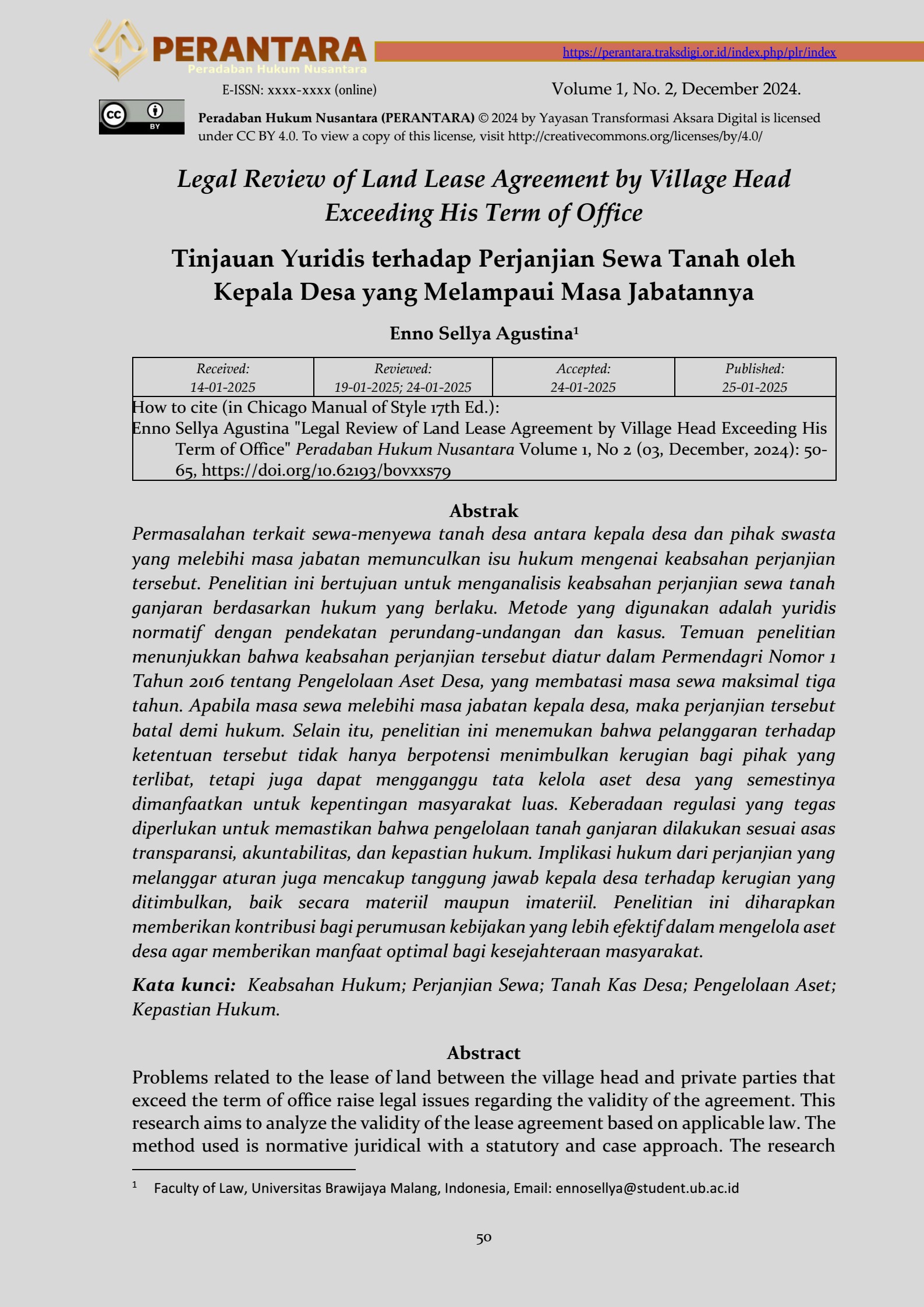
  4. Legal Review of Land Lease Agreement by Village Head Exceeding His Term of Office: Tinjauan Yuridis terhadap Perjanjian Sewa Tanah oleh Kepala Desa yang Melampaui Masa Jabatannya

    Problems related to the lease of land between the village head and private parties that exceed the term of office raise legal issues regarding the validity of the agreement. This research aims to analyze the validity of the lease agreement based on applicable law. The method used is normative juridical with a statutory and case approach. The research findings show that the validity of the agreement is regulated in Permendagri Number 1 of 2016 concerning Village Asset Management, which limits the lease period to a maximum of three years. If the lease period exceeds the term of office of the village head, the agreement is null and void. In addition, this study found that violations of these provisions not only have the potential to cause losses to the parties involved, but can also disrupt the governance of village assets that should be utilized for the benefit of the wider community. The existence of strict regulations is necessary to ensure that the management of ganjaran land is carried out in accordance with the principles of transparency, accountability, and legal certainty. The legal implications of agreements that violate the rules also include the responsibility of the village head for the losses incurred, both materially and immaterially. This research is expected to contribute to the formulation of more effective policies in managing village assets in order to provide optimal benefits for the welfare of the community.

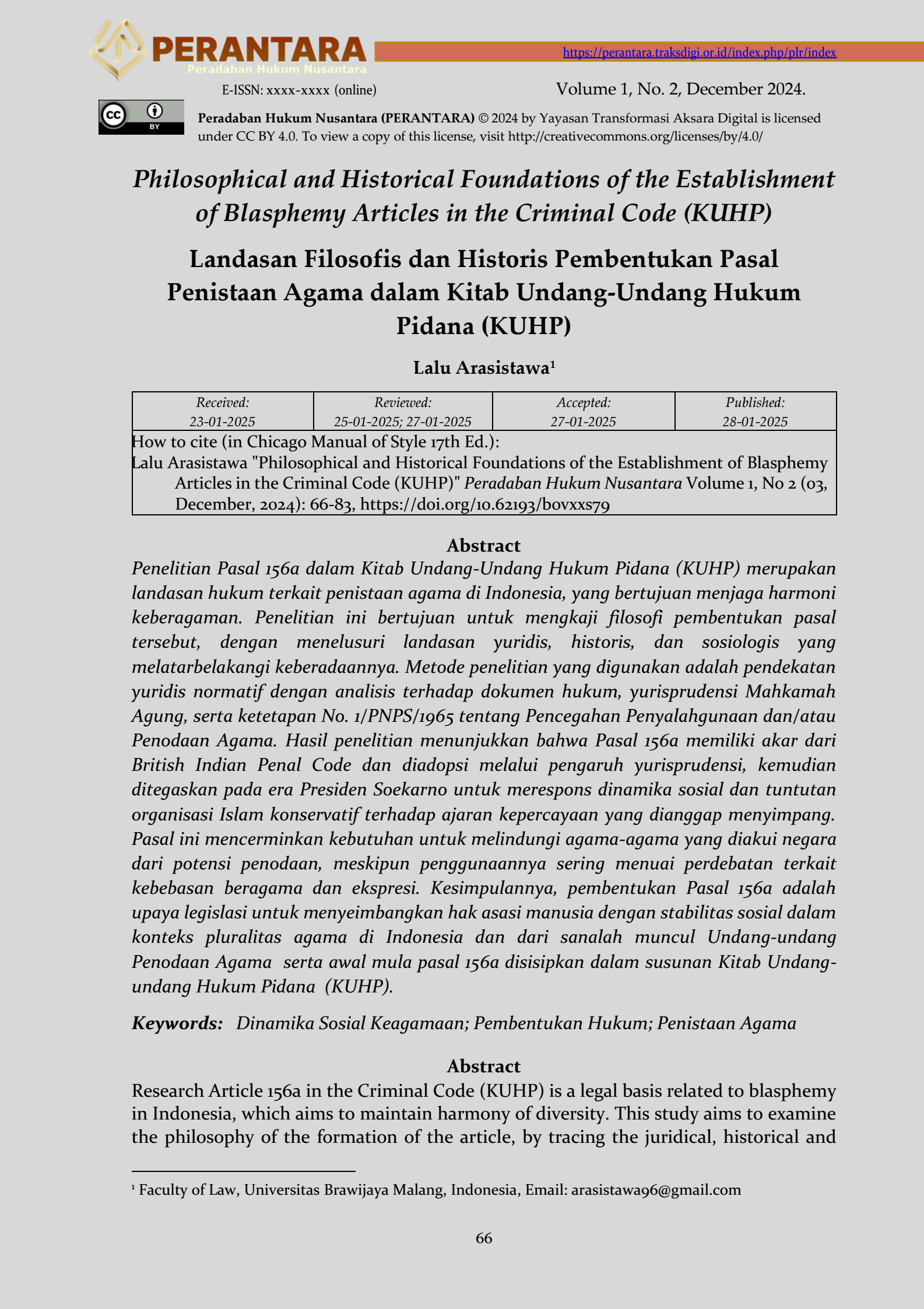
  5. Philosophical and Historical Foundations of the Establishment of Blasphemy Articles in the Criminal Code (KUHP): Landasan Filosofis dan Historis Pembentukan Pasal Penistaan Agama dalam Kitab Undang-Undang Hukum Pidana (KUHP)

    Research Article 156a in the Criminal Code (KUHP) is a legal basis related to blasphemy in Indonesia, which aims to maintain harmony of diversity. This study aims to examine the philosophy of the formation of the article, by tracing the juridical, historical and sociological foundations behind its existence. The research method used is a normative juridical approach by analyzing legal documents, Supreme Court jurisprudence, and Decree No. 1/PNPS/1965 on the Prevention of Abuse and/or Blasphemy of Religion. The results show that Article 156a has roots in the British Indian Penal Code and was adopted through the influence of jurisprudence, then affirmed in the era of President Soekarno to respond to social dynamics and demands of conservative Islamic organizations against belief teachings that are considered deviant. The article reflects the need to protect state-recognized religions from potential blasphemy, although its use is often debated in relation to freedom of religion and expression. In conclusion, the establishment of Article 156a was a legislative effort to balance human rights with social stability in the context of religious plurality in Indonesia, from which emerged the blasphemy law and the beginning of Article 156a's inclusion in the composition of the Criminal Code (KUHP).

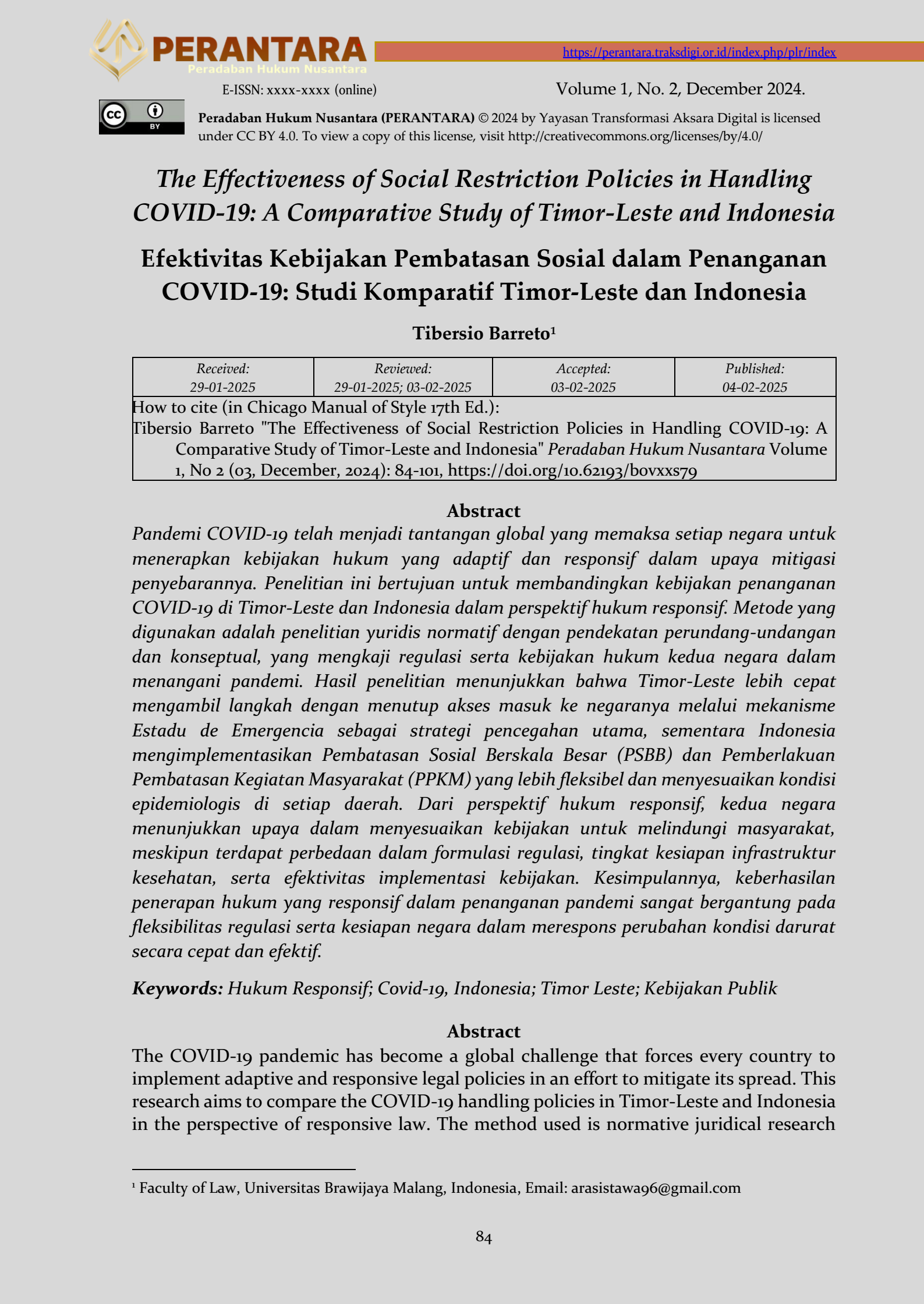
  6. The Effectiveness of Social Restriction Policies in Handling COVID-19: A Comparative Study of Timor-Leste and Indonesia: Efektivitas Kebijakan Pembatasan Sosial dalam Penanganan COVID-19: Studi Komparatif Timor-Leste dan Indonesia

    The COVID-19 pandemic has become a global challenge that forces every country to implement adaptive and responsive legal policies in an effort to mitigate its spread. This research aims to compare the COVID-19 handling policies in Timor-Leste and Indonesia in the perspective of responsive law. The method used is normative juridical research with a statutory and conceptual approach, which examines the regulations and legal policies of the two countries in handling the pandemic. The results showed that Timor-Leste was quicker to take steps by closing access to the country through the Estadu de Emergencia mechanism as the main prevention strategy, while Indonesia implemented Large-Scale Social Restrictions (PSBB) and the Enforcement of Restrictions on Community Activities (PPKM) which were more flexible and adjusted the epidemiological conditions in each region. From a responsive law perspective, both countries show efforts in adjusting policies to protect the public, although there are differences in the formulation of regulations, the level of health infrastructure readiness, and the effectiveness of policy implementation. In conclusion, the successful implementation of responsive law in handling a pandemic is highly dependent on the flexibility of regulations and the readiness of the state to respond to changes in emergency conditions quickly and effectively.

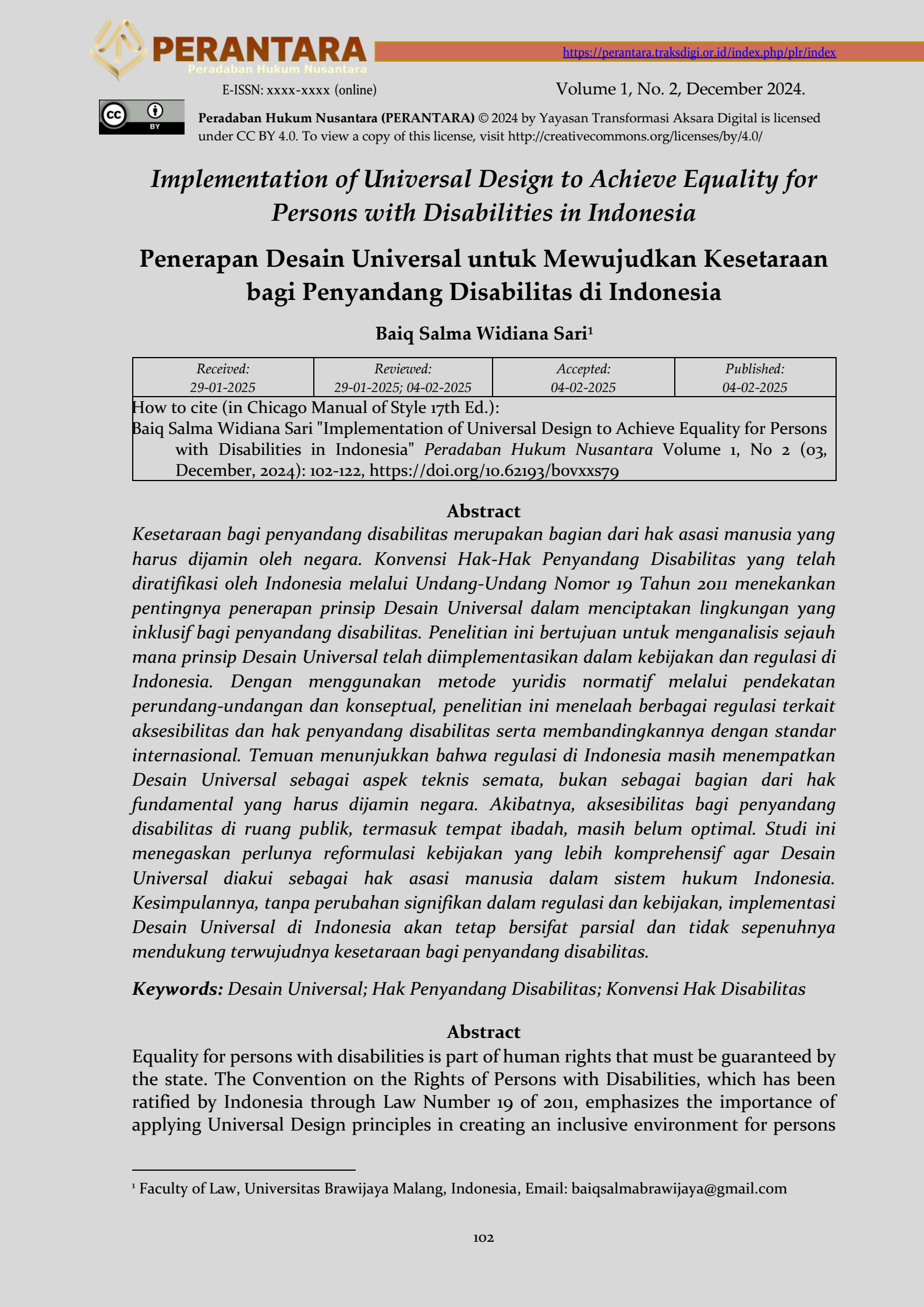
  7. Implementation of Universal Design to Achieve Equality for Persons with Disabilities in Indonesia: Penerapan Desain Universal untuk Mewujudkan Kesetaraan bagi Penyandang Disabilitas di Indonesia

    Equality for persons with disabilities is part of human rights that must be guaranteed by the state. The Convention on the Rights of Persons with Disabilities, which has been ratified by Indonesia through Law Number 19 of 2011, emphasizes the importance of applying Universal Design principles in creating an inclusive environment for persons with disabilities. This research aims to analyze the extent to which Universal Design principles have been implemented in policies and regulations in Indonesia. Using a normative juridical method through legislative and conceptual approaches, this research examines various regulations related to accessibility and the rights of persons with disabilities and compares them with international standards. The findings show that regulations in Indonesia still place Universal Design as a mere technical aspect, not as part of the fundamental rights that the state must guarantee. As a result, accessibility for persons with disabilities in public spaces, including places of worship, is still not optimal. This study confirms the need for a more comprehensive policy reformulation so that Universal Design is recognized as a human right in the Indonesian legal system. In conclusion, without significant changes in regulations and policies, the implementation of Universal Design in Indonesia will remain partial and not fully support the realization of equality for persons with disabilities.

  8. Legal Implications of Insurance Supervisor's Liability in Policy Failure: Implikasi Hukum atas Tanggung Jawab Pengawas Asuransi dalam Kegagalan Polis

    The ambiguity of the norms in Article 15 of Insurance Law Number 40 of 2014 has led to multiple interpretations in practice, especially in relation to the scope of the responsibility of the controller of an insurance company in the case of policyholder default. This study aims to analyze the limits of the responsibility of the controller of an insurance company for the default of policyholders by referring to the case of PT Asuransi Jiwasraya in case 676/PDT/2021/PT DKI. This research uses a normative legal method with a statutory approach, conceptual approach, and case approach, and is analyzed using grammatical and systematic interpretation. The results show that there is legal uncertainty in the regulation of the responsibility of the controller of the insurance company, which has an impact on legal protection for policyholders. This finding confirms the need for more explicit regulations regarding the scope of controlling liability in order to provide legal certainty and more optimal protection for policyholders. Therefore, the recommendations include the need for revision of related regulations as well as strengthening the supervision mechanism of insurance company controllers.